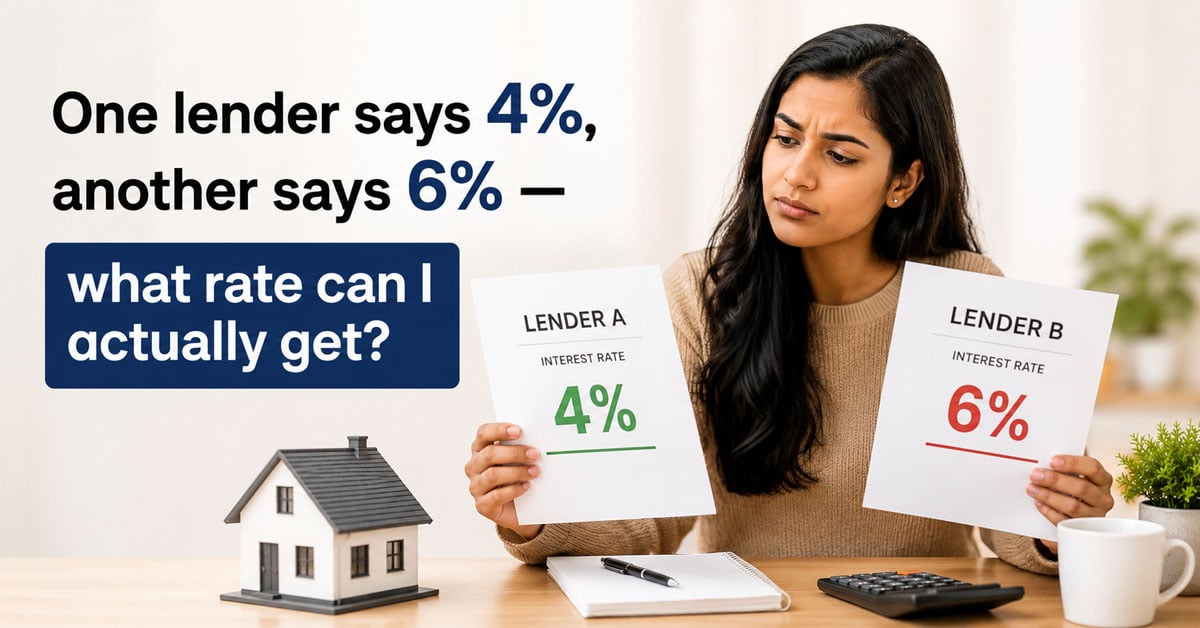
One lender says 4%, another says 6% — what rate can I actually get?
Local Guide Sankari Subburaman August 29, 2026
Local Guide Sankari Subburaman August 29, 2026
If two lenders quote 4% and 6% for what appears to be the same home loan, it is natural to wonder which number is real. The answer is usually more complicated than choosing the lower rate.
As a Redmond Realtor, I often see buyers focus on the headline rate before looking at the terms behind it. A lender may advertise a rate that requires excellent credit, a specific loan structure, discount points, or other conditions that do not apply to every borrower. Another lender may quote a higher rate but offer different fees or fewer upfront costs. I believe the better question is not simply, "Which lender has the lowest rate?" It is, "What rate can I realistically qualify for and what will that loan actually cost me?"
In this blog, I will explain why lenders can quote different rates, what determines the rate you personally receive and how to compare loan offers without getting distracted by the lowest number on the page.
Mortgage rates are not one-size-fits-all. Even when two lenders are looking at the same purchase price, their offers can differ because they may be using different loan programs, pricing structures, or assumptions about the borrower.
The advertised rate is often a starting point. Your actual rate can depend on your credit profile, down payment, debt-to-income ratio, loan amount, property type, loan term and whether you choose to pay discount points.
That is why I would not make a decision based on a verbal quote alone.
A lender saying "I can get you 4%" sounds compelling. But I want to know what sits behind that 4%. Is it a 30-year fixed loan? Does it require points? Is the rate locked? What are the lender fees? Is the quote based on a particular credit score or down payment?
Those details can completely change the comparison.
Your financial profile is one of the biggest factors lenders consider when pricing a mortgage.
A strong credit profile can put you in a better position to qualify for competitive terms. Your income, existing debts, employment history, assets and payment history can also affect how a lender evaluates your application.
I always encourage buyers to look beyond the number they see on a credit app. The score a lender uses and the broader financial information reviewed during underwriting matter when determining the terms you actually receive.
If your financial profile has changed recently, it is also worth discussing that with the lender before assuming an advertised rate applies to you.
The amount you put down can affect more than how much you borrow.
A larger down payment may reduce the loan amount and can sometimes improve the overall terms available to you. A smaller down payment may preserve more of your cash, but the loan structure and associated costs can be different.
That does not mean putting the most money down is automatically the smartest move.
I prefer to look at the complete financial picture. A buyer may have enough cash to make a larger down payment but may also want to preserve funds for moving expenses, renovations, emergency reserves, or other priorities.
The right financing decision should support the entire purchase, not just produce a lower monthly payment.
This is where many buyers get caught.
A 4% mortgage can sound dramatically better than a 6% mortgage, but the lower rate may come with higher upfront costs. Discount points, lender fees and other charges can change the economics of the offer.
When comparing lenders, I recommend asking for the numbers in writing and looking at:
The APR is particularly useful because it can give you a broader view of the borrowing cost than the interest rate alone. It still does not tell the entire story, but it can help expose differences between seemingly similar offers.
Suppose one lender offers 4% and another offers 6%.
Before deciding that the first lender is obviously better, I would ask both lenders to quote the same basic scenario. The loan amount, loan term, down payment, property type and other major assumptions should be as comparable as possible.
Then look at what you are paying to receive each rate.
For example, if the 4% offer requires substantial discount points while the 6% offer has significantly lower upfront costs, the decision becomes more nuanced. If you plan to own the property for many years, paying more upfront for a lower rate could potentially make sense. If you expect to refinance or move sooner, the calculation may look very different.
There is no universal answer.
I do not recommend accepting the first mortgage offer simply because the lender sounds confident.
Comparing lenders can give you a much clearer picture of the market available to you. My own guidance to buyers is consistent on this point: compare at least two or three options, get pre-approved and ask questions about anything that is unclear.
When lenders know you are comparing offers, you are also in a better position to understand where their pricing differs.
Just make sure the comparison is fair. Ask each lender to provide a quote based on the same purchase scenario. Otherwise, you may end up comparing two completely different loan products.
There is no honest way to determine your exact mortgage rate from an advertised number alone.
Your actual rate will depend on your financial profile, the loan program, current market pricing, the property, your down payment and the specific terms of the lender's offer.
That is why pre-approval matters. It moves the conversation from "What rate is being advertised?" to "What terms can I qualify for based on my situation?"
I also encourage buyers to pay attention to the monthly payment and total borrowing costs rather than becoming overly focused on winning the lowest possible rate. A mortgage is a long-term financial commitment. A slightly higher rate with favorable terms can sometimes make more sense than a very low rate that requires significant upfront costs.
When I guide a buyer through a purchase, I want the financing conversation to connect with the property decision. The loan affects purchasing power, monthly expenses, cash reserves and ultimately which homes make financial sense.
For buyers considering homes in Kirkland, the numbers can look very different depending on the purchase price and financing structure. The same principle applies when evaluating properties in Bothell or comparing opportunities across different parts of the Eastside.
I do not replace the lender's role and I do not determine mortgage terms. What I can do is help buyers understand how financing fits into the overall home-buying strategy and make sure the conversation stays connected to the purchase they are actually considering.
If one lender says 4% and another says 6%, do not assume one is being dishonest or that the lower number is automatically the better deal.
There may be a completely different loan structure behind each quote.
My approach is simple: compare the full offer, understand the upfront costs, confirm the loan terms and make sure the monthly payment fits comfortably within your financial plan. A mortgage should support your home purchase, not create unnecessary pressure after closing.
If you are planning to buy and want a clearer understanding of how financing affects your home search, I can help you evaluate the real estate side of the decision alongside your lender's numbers. As a Realtor in Seattle, I focus on giving buyers practical, personalized guidance so they can move forward with greater clarity and confidence.
Stay up to date on the latest real estate trends.

Local Guide
Local Guide
Local Guide

Local Guide

Local Guide

Local Guide

Local Guide

Local Guide