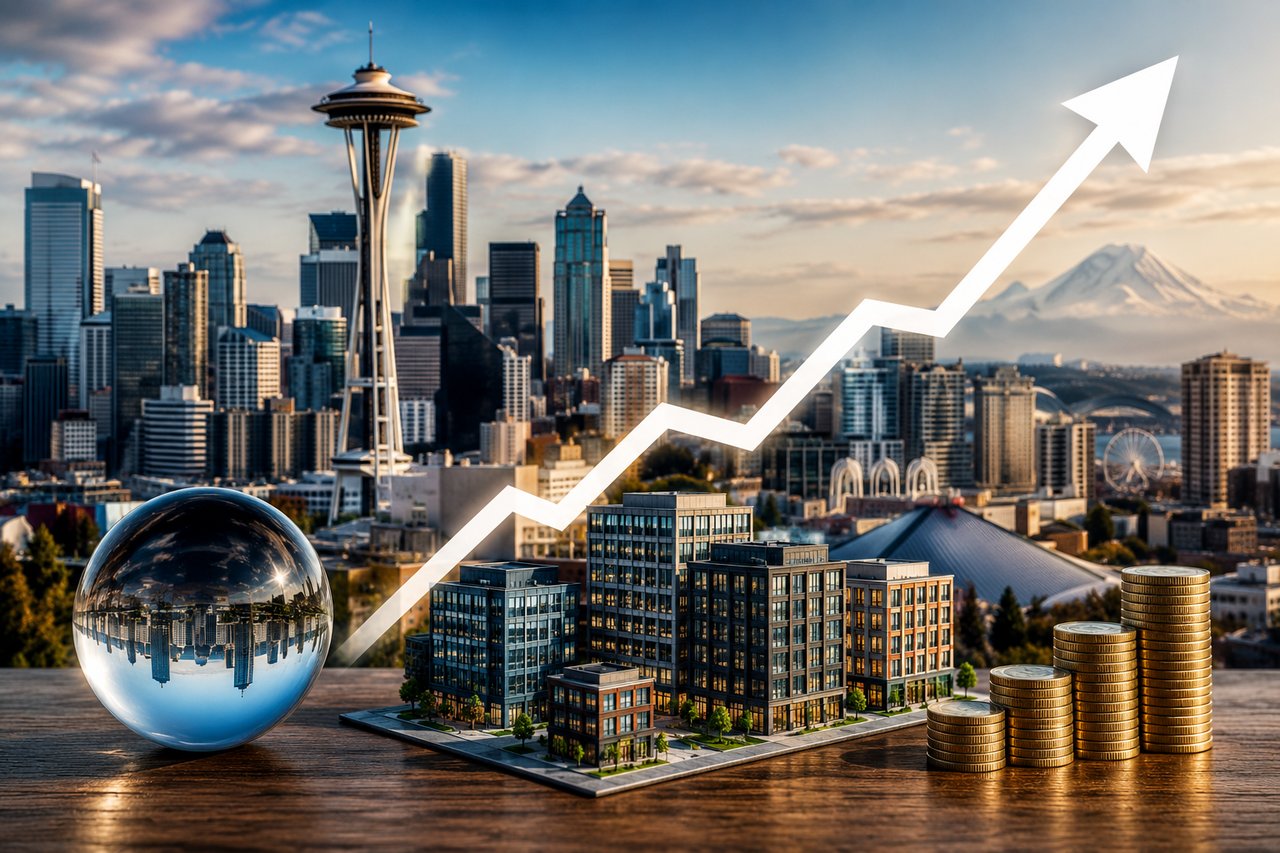
Real Estate Market Predictions for 2026
January 21, 2026
January 21, 2026
Trying to predict the future of real estate has never been simple. In a market shaped by economic uncertainty, shifting mortgage rates, and cautious buyer behavior, it becomes even more complex. As a top Realtor in Seattle trusted by homeowners and buyers alike, I do not believe in pretending to know exact turning points. My focus has always been on helping people understand the market as it exists today and make confident decisions within it.
Markets move based on pressure and psychology, not headlines. Experience has shown me that clarity matters more than certainty. In this blog, I look at the forces shaping the Greater Seattle real estate market as we move through 2026 and what they mean for buyers and sellers right now.
I do not treat forecasts as promises. No professional can reliably predict the exact moment when prices will rise or fall. What matters far more is understanding direction and risk as conditions evolve.
There are two areas of the market that consistently resist precision:
The size of a move, whether prices rise modestly or sharply
The timing of that move and when momentum truly shifts
These unknowns are what make timing the market so difficult. Rather than trying to outguess them, I focus on identifying the forces shaping demand and confidence in real time.
From roughly June through December of 2025, much of Greater Seattle and King County experienced a noticeable reset. Median price per square foot declined by approximately 10 to 15 percent across many areas. Homes that once attracted aggressive competition began receiving one or two offers instead. Five-offer situations became uncommon, and bidding wars with ten or more offers largely disappeared.
This shift was not caused by a lack of qualified buyers. Many remained financially ready. The hesitation stemmed from uncertainty, particularly around job stability in the tech sector. Even well-prepared buyers paused, not because they could not purchase, but because confidence weakened.
At the same time, mortgage rates dropped nearly one percentage point from recent highs, moving from the high six percent range into the high five percent range for many borrowers. Under traditional economic models, falling rates should push prices higher. Instead, prices and rates declined together. That tells me rate relief alone has not been enough to overcome broader economic concerns.
Several key factors continue to shape market behavior and determine when momentum may return. These pressures do not act independently; they overlap and compound.
Employment trends, particularly in technology-driven sectors, remain closely tied to buyer confidence
Mortgage rates affect both affordability and psychology, often at different speeds
Public policy decisions related to housing and lending can accelerate or delay shifts unexpectedly
None of these forces provide clean signals on their own. Reading the market requires watching how they interact over time.
Seasonality continues to play a consistent role in pricing and activity. Historically, real estate momentum builds from January through early summer, softens midyear, and slows from October through December. Even when economic or policy conditions improve, timing still matters.
If momentum begins late in the year, seasonality often takes over. This is why I caution clients against assuming that positive news alone will immediately change market behavior.
Real estate is never one-size-fits-all. Neighborhood-level dynamics matter far more than regional headlines. I see this clearly across Kirkland, Bothell, Redmond, and Sammamish.
Well-located homes priced accurately continue to attract serious buyers. Properties that miss the mark tend to sit longer and require adjustments. In Redmond especially, buyer behavior has become more analytical. Experience and local insight now matter more than momentum.
This is where working with knowledgeable real estate agents in Redmond WA makes a measurable difference. Strategy, pricing, and negotiation carry significantly more weight in a selective market.
If mortgage rates continue trending downward over the next year, buyer demand will eventually respond. I believe there is roughly a 60 to 70 percent chance that sidelined buyers will return once rates reach a level that feels psychologically comfortable.
The timing of that return depends on three key variables:
Job stabilization or renewed hiring, which would restore confidence more quickly
Public policy actions related to housing finance that may influence lending conditions
Seasonal timing, which will determine how much momentum can build before year-end
If positive signals emerge late in the year, activity may remain muted until the following spring.
The biggest mistake I see is people making decisions based purely on predictions. Trying to outsmart the market often leads to hesitation or regret. Understanding the forces at play is far more valuable.
Sankari Realty approaches every transaction with that mindset. The goal is not to predict the future but to reduce risk, manage expectations, and negotiate effectively within current conditions.
It is difficult to say when the market will pick up, how strong the next seller-friendly phase will be, or how quickly conditions may change. What I do believe is that activity will increase again over time. Real estate cycles always do.
Preparation beats prediction. Buyers and sellers who understand today’s pressures are better positioned to act with clarity rather than fear.
Stay up to date on the latest real estate trends.

Local Guide

Local Guide
Local Guide